HowMany.wiki
Contact Us!
Please get in touch with us if you:
- Have any suggestions
- Have any questions
- Have found an error/bug
- Anything else ...
To contact us, please click HERE.
Oil — Kg in Ml
1 kg of oil equals 1060 ml*
Density-based conversion — ingredient densities cross-checked against the FAO/INFOODS density database and USDA FoodData Central. The exact weight varies slightly with brand and packing. How we calculate · Reviewed August 21, 2026.
About oil measurements
Cooking oils cluster below water in density; the reference used here is about 0.95 g/ml, near 224 g per US cup. The exact figure shifts with the oil — light vegetable oils run a bit lighter, refined coconut heavier — and every oil thins and lightens noticeably as it warms.
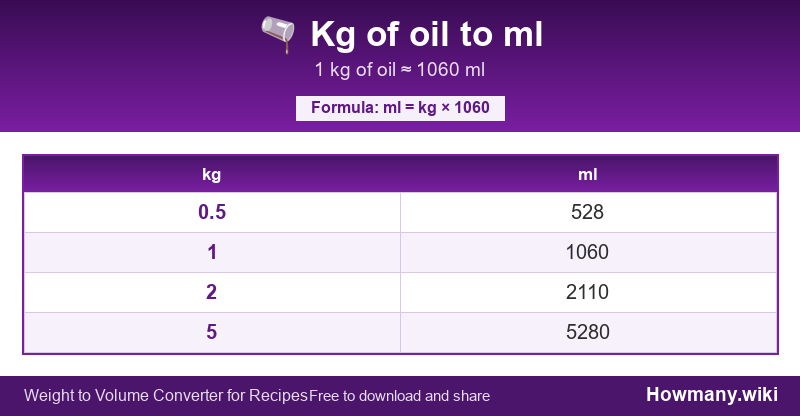
Kg of oil equivalent in ml?
FAQs on oil weight to volume conversion
1 kg of oil equals how many ml?
1 kg of oil is equivalent 1060 ml.
How much is 1060 ml of oil in kg?
1060 ml of oil equals 1 kg.
Oil Conversion Chart Near 1 Kg
| Kg to Ml of Oil | |
|---|---|
| 1 kg | 1060 ml |
| 1.1 kg | 1160 ml |
| 1.2 kg | 1270 ml |
| 1.3 kg | 1370 ml |
| 1.4 kg | 1480 ml |
| 1.5 kg | 1580 ml |
| 1.6 kg | 1690 ml |
| 1.7 kg | 1800 ml |
| 1.8 kg | 1900 ml |
| 1.9 kg | 2010 ml |
| 2 kg | 2110 ml |
| 2.1 kg | 2220 ml |
| 2.2 kg | 2320 ml |
| 2.3 kg | 2430 ml |
| 2.4 kg | 2530 ml |
| 2.5 kg | 2640 ml |
| 2.6 kg | 2750 ml |
| 2.7 kg | 2850 ml |
| 2.8 kg | 2960 ml |
| 2.9 kg | 3060 ml |
| 3 kg | 3170 ml |
| 3.1 kg | 3270 ml |
| 3.2 kg | 3380 ml |
| 3.3 kg | 3480 ml |
| 3.4 kg | 3590 ml |
Note: Values are rounded to 3 significant figures. Fractions are rounded to common recipe fractions (1/8, 1/4, 1/3, 1/2, 2/3, 3/4…).
References:
Weight to Volume Conversions - Recipes
A note on cooking ingredients measurements
Notes: results are rounded (by default) to 3 significant figures. Cooking conversions use standard ingredient densities — the exact weight varies slightly with the brand and how tightly the ingredient is packed ☺.