HowMany.wiki
Contact Us!
Please get in touch with us if you:
- Have any suggestions
- Have any questions
- Have found an error/bug
- Anything else ...
To contact us, please click HERE.
30 Ml of Milk Powder in Grams
How many grams of milk powder in 30 ml?
30 ml of milk powder equals 15.8 grams*
About milk powder measurements
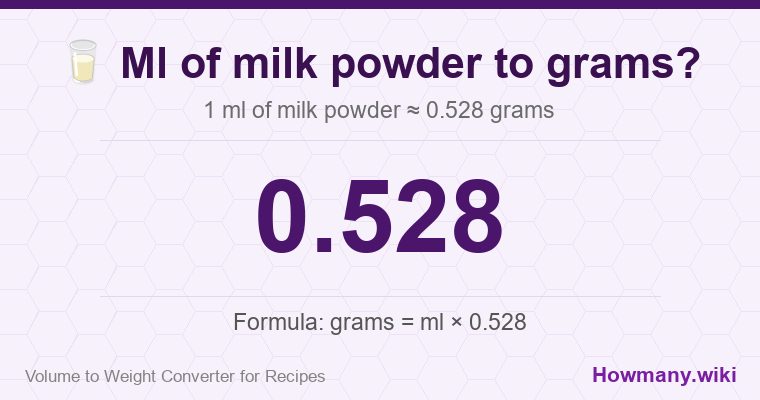
Powdered milk has a reference density near 0.53 g/ml, about 125 g per US cup, but it settles and compacts easily. Instant, agglomerated milk powder is fluffier and lighter per cup than regular fine powder, and scooping from a packed tin adds a good deal of weight — spoon and level it.
Ml of milk powder equivalent in grams?
FAQs on milk powder volume to weight conversion
Is 30 ml of milk powder 15.8 grams?
Yes — 30 ml of milk powder weighs 15.8 grams, based on a density of 0.528 g/ml.
30 ml of milk powder equals how many grams?
30 ml of milk powder is equivalent 15.8 grams.
How much is 15.8 grams of milk powder in ml?
15.8 grams of milk powder equals 30 ml.
Milk Powder Conversion Chart Near 12 Milliliters
| Milliliters to Grams of Milk powder | |
|---|---|
| 12 milliliters | 6.34 grams |
| 13 milliliters | 6.86 grams |
| 14 milliliters | 7.39 grams |
| 15 milliliters | 7.92 grams |
| 16 milliliters | 8.45 grams |
| 17 milliliters | 8.98 grams |
| 18 milliliters | 9.5 grams |
| 19 milliliters | 10 grams |
| 20 milliliters | 10.6 grams |
| 21 milliliters | 11.1 grams |
| 22 milliliters | 11.6 grams |
| 23 milliliters | 12.1 grams |
| 24 milliliters | 12.7 grams |
| 25 milliliters | 13.2 grams |
| 26 milliliters | 13.7 grams |
| 27 milliliters | 14.3 grams |
| 28 milliliters | 14.8 grams |
| 29 milliliters | 15.3 grams |
| 30 milliliters | 15.8 grams |
| 31 milliliters | 16.4 grams |
| 32 milliliters | 16.9 grams |
| 33 milliliters | 17.4 grams |
| 34 milliliters | 18 grams |
| 35 milliliters | 18.5 grams |
| 36 milliliters | 19 grams |
| 37 milliliters | 19.5 grams |
| 38 milliliters | 20.1 grams |
| 39 milliliters | 20.6 grams |
| 40 milliliters | 21.1 grams |
| 41 milliliters | 21.6 grams |
| 42 milliliters | 22.2 grams |
| 43 milliliters | 22.7 grams |
| 44 milliliters | 23.2 grams |
| 45 milliliters | 23.8 grams |
| 46 milliliters | 24.3 grams |
| 47 milliliters | 24.8 grams |
| 48 milliliters | 25.3 grams |
Note: Values are rounded to 3 significant figures. Fractions are rounded to common recipe fractions (1/8, 1/4, 1/3, 1/2, 2/3, 3/4…).
References:
Popular Volume to Weight Conversions
A note on cooking ingredients measurements
Notes: results are rounded (by default) to 3 significant figures. Cooking conversions use standard ingredient densities — the exact weight varies slightly with the brand and how tightly the ingredient is packed ☺.