HowMany.wiki
Contact Us!
Please get in touch with us if you:
- Have any suggestions
- Have any questions
- Have found an error/bug
- Anything else ...
To contact us, please click HERE.
Water — Ml in Ounces
How many ounces of water in 1 ml?
1 ml of water equals 0.0353 ounces*
About water measurements
Water is the reference point for every other ingredient here, with a density of 1.0 g/ml, so one US cup is 237 g. It peaks near 1.000 g/ml at about 4°C and thins slightly as it warms, so hot water measured by volume weighs a touch less than cold.
Ml of water equivalent in ounces?
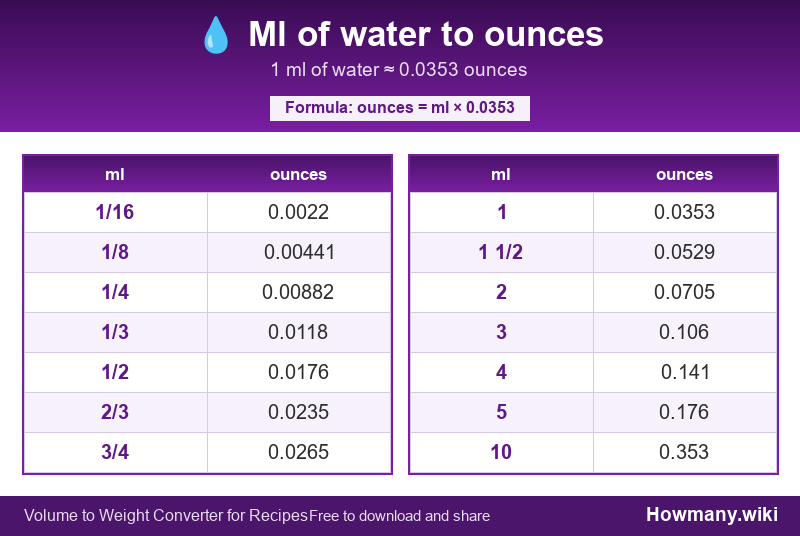
FAQs on water volume to weight conversion
1 ml of water equals how many ounces?
1 ml of water is equivalent 0.0353 ounces.
How much is 0.0353 ounces of water in ml?
0.0353 ounces of water equals 1 ml.
Water Conversion Chart Near 1 Milliliter
| Milliliters to Ounces of Water | |
|---|---|
| 1 milliliter | 0.0353 ounces |
| 1.1 milliliters | 0.0388 ounces |
| 1.2 milliliters | 0.0423 ounces |
| 1.3 milliliters | 0.0459 ounces |
| 1.4 milliliters | 0.0494 ounces |
| 1.5 milliliters | 0.0529 ounces |
| 1.6 milliliters | 0.0564 ounces |
| 1.7 milliliters | 0.06 ounces |
| 1.8 milliliters | 0.0635 ( ~ 1/8) ounces |
| 1.9 milliliters | 0.067 ( ~ 1/8) ounces |
| 2 milliliters | 0.0705 ( ~ 1/8) ounces |
| 2.1 milliliters | 0.0741 ( ~ 1/8) ounces |
| 2.2 milliliters | 0.0776 ( ~ 1/8) ounces |
| 2.3 milliliters | 0.0811 ( ~ 1/8) ounces |
| 2.4 milliliters | 0.0847 ( ~ 1/8) ounces |
| 2.5 milliliters | 0.0882 ( ~ 1/8) ounces |
| 2.6 milliliters | 0.0917 ( ~ 1/8) ounces |
| 2.7 milliliters | 0.0952 ( ~ 1/8) ounces |
| 2.8 milliliters | 0.0988 ( ~ 1/8) ounces |
| 2.9 milliliters | 0.102 ( ~ 1/8) ounces |
| 3 milliliters | 0.106 ( ~ 1/8) ounces |
| 3.1 milliliters | 0.109 ( ~ 1/8) ounces |
| 3.2 milliliters | 0.113 ( ~ 1/8) ounces |
| 3.3 milliliters | 0.116 ( ~ 1/8) ounces |
| 3.4 milliliters | 0.12 ( ~ 1/8) ounces |
| 3.5 milliliters | 0.123 ( ~ 1/8) ounces |
| 3.6 milliliters | 0.127 ( ~ 1/8) ounces |
| 3.7 milliliters | 0.131 ( ~ 1/8) ounces |
| 3.8 milliliters | 0.134 ( ~ 1/8) ounces |
| 3.9 milliliters | 0.138 ( ~ 1/8) ounces |
| 4 milliliters | 0.141 ( ~ 1/8) ounces |
| 4.1 milliliters | 0.145 ( ~ 1/8) ounces |
| 4.2 milliliters | 0.148 ( ~ 1/8) ounces |
| 4.3 milliliters | 0.152 ( ~ 1/8) ounces |
| 4.4 milliliters | 0.155 ( ~ 1/8) ounces |
| 4.5 milliliters | 0.159 ( ~ 1/8) ounces |
| 4.6 milliliters | 0.162 ( ~ 1/8) ounces |
Note: Values are rounded to 3 significant figures. Fractions are rounded to common recipe fractions (1/8, 1/4, 1/3, 1/2, 2/3, 3/4…).
References:
Popular Volume to Weight Conversions
A note on cooking ingredients measurements
Notes: results are rounded (by default) to 3 significant figures. Cooking conversions use standard ingredient densities — the exact weight varies slightly with the brand and how tightly the ingredient is packed ☺.