HowMany.wiki
Contact Us!
Please get in touch with us if you:
- Have any suggestions
- Have any questions
- Have found an error/bug
- Anything else ...
To contact us, please click HERE.
Table Salt — Grams in Ml
1 gram of table salt equals 0.822 ml*
Density-based conversion — ingredient densities cross-checked against the FAO/INFOODS density database and USDA FoodData Central. The exact weight varies slightly with brand and packing. How we calculate · Reviewed August 21, 2026.
About table salt measurements
Fine table salt is dense — near 1.22 g/ml, about 288 g per US cup — because its tiny cubes pack with almost no gaps. Swap in flaky kosher or coarse sea salt and the very same spoon weighs far less, which is why salt should never be substituted by volume alone.
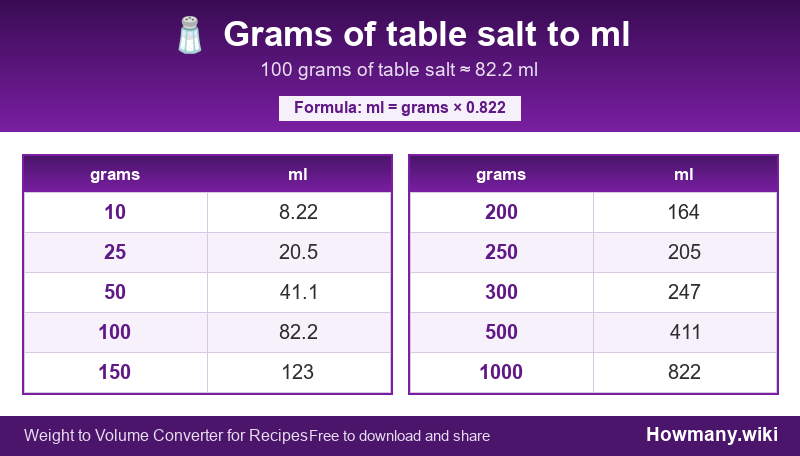
Grams of table salt equivalent in ml?
FAQs on table salt weight to volume conversion
1 gram of table salt equals how many ml?
1 gram of table salt is equivalent 0.822 ml.
How much is 0.822 ml of table salt in grams?
0.822 ml of table salt equals 1 gram.
Table salt: Grams to ml — common amounts
| Grams | Ml |
|---|---|
| 10 grams | 8.22 ml |
| 25 grams | 20.5 ml |
| 50 grams | 41.1 ml |
| 100 grams | 82.2 ml |
| 150 grams | 123 ml |
| 200 grams | 164 ml |
| 250 grams | 205 ml |
| 300 grams | 247 ml |
| 500 grams | 411 ml |
| 1000 grams | 822 ml |
Weight to Volume Conversions - Recipes
A note on cooking ingredients measurements
Notes: results are rounded (by default) to 3 significant figures. Cooking conversions use standard ingredient densities — the exact weight varies slightly with the brand and how tightly the ingredient is packed ☺.