HowMany.wiki
Contact Us!
Please get in touch with us if you:
- Have any suggestions
- Have any questions
- Have found an error/bug
- Anything else ...
To contact us, please click HERE.
Sesame Oil — Grams in Milliliters
1 gram of sesame oil equals 1.08 milliliters*
1.08milliliters
0.923grams per milliliter
Density-based conversion — ingredient densities cross-checked against the FAO/INFOODS density database and USDA FoodData Central. The exact weight varies slightly with brand and packing. How we calculate · Reviewed August 21, 2026.
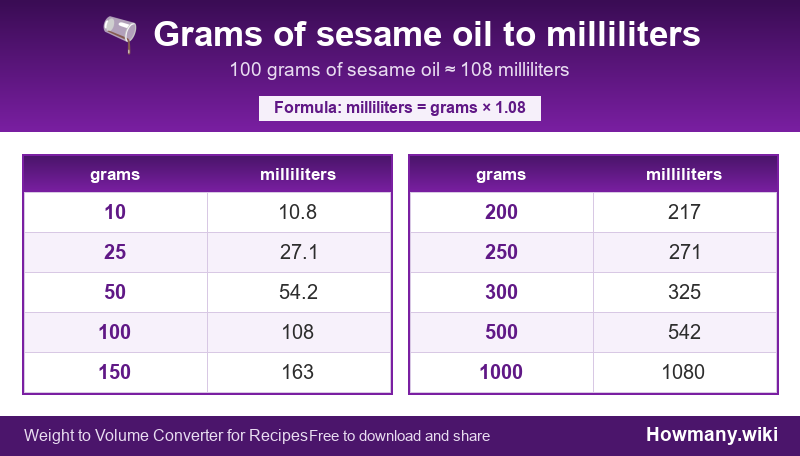
Grams of sesame oil equivalent in milliliters?
FAQs on sesame oil weight to volume conversion
1 gram of sesame oil equals how many milliliters?
1 gram of sesame oil is equivalent 1.08 milliliters.
How much is 1.08 milliliters of sesame oil in grams?
1.08 milliliters of sesame oil equals 1 gram.
Sesame oil: Grams to milliliters — common amounts
| Grams | Milliliters |
|---|---|
| 10 grams | 10.8 milliliters |
| 25 grams | 27.1 milliliters |
| 50 grams | 54.2 milliliters |
| 100 grams | 108 milliliters |
| 150 grams | 163 milliliters |
| 200 grams | 217 milliliters |
| 250 grams | 271 milliliters |
| 300 grams | 325 milliliters |
| 500 grams | 542 milliliters |
| 1000 grams | 1080 milliliters |
Weight to Volume Conversions - Recipes
A note on cooking ingredients measurements
Notes: results are rounded (by default) to 3 significant figures. Cooking conversions use standard ingredient densities — the exact weight varies slightly with the brand and how tightly the ingredient is packed ☺.