HowMany.wiki
Contact Us!
Please get in touch with us if you:
- Have any suggestions
- Have any questions
- Have found an error/bug
- Anything else ...
To contact us, please click HERE.
700 Ml of Tomato Sauce in Ounces
How many ounces of tomato sauce in 700 ml?
700 ml of tomato sauce equals 23.5 ( ~ 23 1/2) ounces*
About tomato sauce measurements
Pourable tomato sauce is thinner than paste, with a reference density near 0.95 g/ml — about 225 g per US cup. Consistency varies by brand and reduction: a thick, slow-simmered marinara carries more solids and weighs a little more per cup than a loose, watery canned sauce.
Ml of tomato sauce equivalent in ounces?
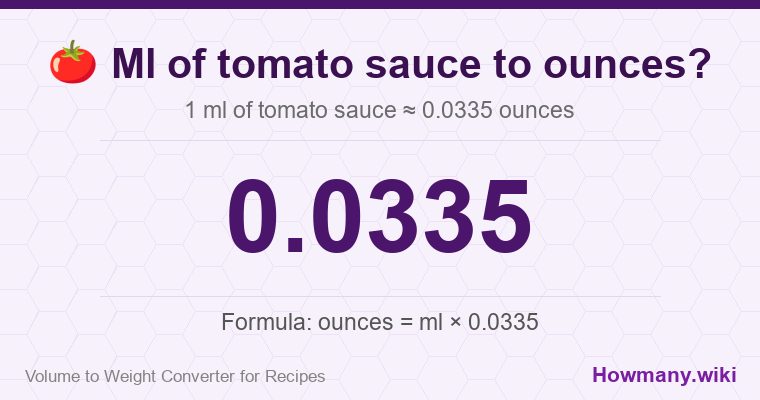
FAQs on tomato sauce volume to weight conversion
Is 700 ml of tomato sauce 23.5 ounces?
Yes — 700 ml of tomato sauce weighs 23.5 ( ~ 23 1/2) ounces, based on a density of 0.951 g/ml.
700 ml of tomato sauce equals how many ounces?
700 ml of tomato sauce is equivalent 23.5 ( ~ 23 1/2) ounces.
How much is 23.5 ounces of tomato sauce in ml?
23.5 ounces of tomato sauce equals 700 ml.
Tomato Sauce Conversion Chart Near 520 Milliliters
| Milliliters to Ounces of Tomato sauce | |
|---|---|
| 520 milliliters | 17.4 ( ~ 17 1/2) ounces |
| 530 milliliters | 17.8 ( ~ 17 3/4) ounces |
| 540 milliliters | 18.1 ( ~ 18 1/8) ounces |
| 550 milliliters | 18.5 ( ~ 18 1/2) ounces |
| 560 milliliters | 18.8 ( ~ 18 3/4) ounces |
| 570 milliliters | 19.1 ( ~ 19 1/8) ounces |
| 580 milliliters | 19.5 ( ~ 19 1/2) ounces |
| 590 milliliters | 19.8 ( ~ 19 3/4) ounces |
| 600 milliliters | 20.1 ( ~ 20 1/8) ounces |
| 610 milliliters | 20.5 ( ~ 20 1/2) ounces |
| 620 milliliters | 20.8 ( ~ 20 3/4) ounces |
| 630 milliliters | 21.1 ( ~ 21 1/8) ounces |
| 640 milliliters | 21.5 ( ~ 21 1/2) ounces |
| 650 milliliters | 21.8 ( ~ 21 3/4) ounces |
| 660 milliliters | 22.1 ( ~ 22 1/8) ounces |
| 670 milliliters | 22.5 ( ~ 22 1/2) ounces |
| 680 milliliters | 22.8 ( ~ 22 3/4) ounces |
| 690 milliliters | 23.1 ( ~ 23 1/8) ounces |
| 700 milliliters | 23.5 ( ~ 23 1/2) ounces |
| 710 milliliters | 23.8 ( ~ 23 3/4) ounces |
| 720 milliliters | 24.2 ( ~ 24 1/8) ounces |
| 730 milliliters | 24.5 ( ~ 24 1/2) ounces |
| 740 milliliters | 24.8 ( ~ 24 3/4) ounces |
| 750 milliliters | 25.2 ( ~ 25 1/8) ounces |
| 760 milliliters | 25.5 ( ~ 25 1/2) ounces |
| 770 milliliters | 25.8 ( ~ 25 3/4) ounces |
| 780 milliliters | 26.2 ( ~ 26 1/8) ounces |
| 790 milliliters | 26.5 ( ~ 26 1/2) ounces |
| 800 milliliters | 26.8 ( ~ 26 3/4) ounces |
| 810 milliliters | 27.2 ( ~ 27 1/8) ounces |
| 820 milliliters | 27.5 ( ~ 27 1/2) ounces |
| 830 milliliters | 27.8 ( ~ 27 3/4) ounces |
| 840 milliliters | 28.2 ( ~ 28 1/8) ounces |
| 850 milliliters | 28.5 ( ~ 28 1/2) ounces |
| 860 milliliters | 28.8 ( ~ 28 3/4) ounces |
| 870 milliliters | 29.2 ( ~ 29 1/8) ounces |
| 880 milliliters | 29.5 ( ~ 29 1/2) ounces |
Note: Values are rounded to 3 significant figures. Fractions are rounded to common recipe fractions (1/8, 1/4, 1/3, 1/2, 2/3, 3/4…).
References:
Popular Volume to Weight Conversions
A note on cooking ingredients measurements
Notes: results are rounded (by default) to 3 significant figures. Cooking conversions use standard ingredient densities — the exact weight varies slightly with the brand and how tightly the ingredient is packed ☺.