HowMany.wiki
Contact Us!
Please get in touch with us if you:
- Have any suggestions
- Have any questions
- Have found an error/bug
- Anything else ...
To contact us, please click HERE.
500 Ml of Milk in Pounds
How many pounds of milk in 500 ml?
500 ml of milk equals 1.14 ( ~ 1 1/8) pounds*
About milk measurements
Milk's density is about 1.04 g/ml (FAO density database), so a US cup weighs roughly 245 g. Counterintuitively, skim milk is slightly denser than whole milk, because milkfat is lighter than water — the more cream that is removed, the heavier the same volume becomes.
Ml of milk equivalent in pounds?
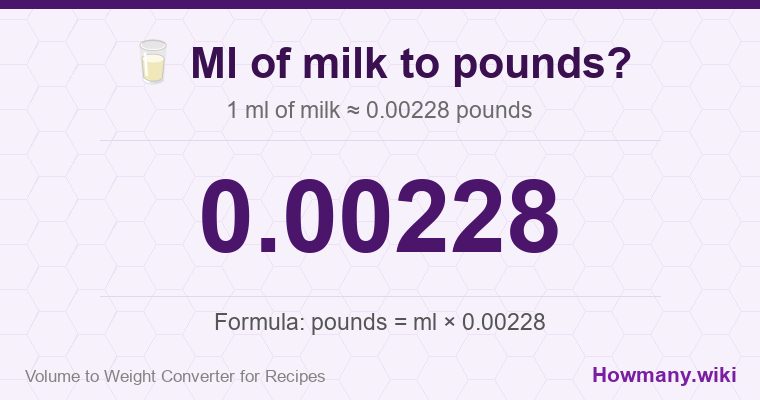
FAQs on milk volume to weight conversion
Is 500 ml of milk 1.14 pounds?
Yes — 500 ml of milk weighs 1.14 ( ~ 1 1/8) pounds, based on a density of 1.04 g/ml.
500 ml of milk equals how many pounds?
500 ml of milk is equivalent 1.14 ( ~ 1 1/8) pounds.
How much is 1.14 pounds of milk in ml?
1.14 pounds of milk equals 500 ml.
Milk Conversion Chart Near 320 Milliliters
| Milliliters to Pounds of Milk | |
|---|---|
| 320 milliliters | 0.731 ( ~ 3/4) pounds |
| 330 milliliters | 0.754 ( ~ 3/4) pounds |
| 340 milliliters | 0.777 ( ~ 3/4) pounds |
| 350 milliliters | 0.799 ( ~ 3/4) pounds |
| 360 milliliters | 0.822 ( ~ 3/4) pounds |
| 370 milliliters | 0.845 ( ~ 3/4) pounds |
| 380 milliliters | 0.868 ( ~ 3/4) pounds |
| 390 milliliters | 0.891 ( ~ 1) pounds |
| 400 milliliters | 0.914 ( ~ 1) pounds |
| 410 milliliters | 0.936 ( ~ 1) pounds |
| 420 milliliters | 0.959 ( ~ 1) pounds |
| 430 milliliters | 0.982 ( ~ 1) pounds |
| 440 milliliters | 1 ( ~ 1) pound |
| 450 milliliters | 1.03 ( ~ 1) pounds |
| 460 milliliters | 1.05 ( ~ 1) pounds |
| 470 milliliters | 1.07 ( ~ 1 1/8) pounds |
| 480 milliliters | 1.1 ( ~ 1 1/8) pounds |
| 490 milliliters | 1.12 ( ~ 1 1/8) pounds |
| 500 milliliters | 1.14 ( ~ 1 1/8) pounds |
| 510 milliliters | 1.16 ( ~ 1 1/8) pounds |
| 520 milliliters | 1.19 ( ~ 1 1/4) pounds |
| 530 milliliters | 1.21 ( ~ 1 1/4) pounds |
| 540 milliliters | 1.23 ( ~ 1 1/4) pounds |
| 550 milliliters | 1.26 ( ~ 1 1/4) pounds |
| 560 milliliters | 1.28 ( ~ 1 1/4) pounds |
| 570 milliliters | 1.3 ( ~ 1 1/3) pounds |
| 580 milliliters | 1.32 ( ~ 1 1/3) pounds |
| 590 milliliters | 1.35 ( ~ 1 1/3) pounds |
| 600 milliliters | 1.37 ( ~ 1 1/3) pounds |
| 610 milliliters | 1.39 ( ~ 1 1/3) pounds |
| 620 milliliters | 1.42 ( ~ 1 1/3) pounds |
| 630 milliliters | 1.44 ( ~ 1 1/2) pounds |
| 640 milliliters | 1.46 ( ~ 1 1/2) pounds |
| 650 milliliters | 1.48 ( ~ 1 1/2) pounds |
| 660 milliliters | 1.51 ( ~ 1 1/2) pounds |
| 670 milliliters | 1.53 ( ~ 1 1/2) pounds |
| 680 milliliters | 1.55 ( ~ 1 1/2) pounds |
Note: Values are rounded to 3 significant figures. Fractions are rounded to common recipe fractions (1/8, 1/4, 1/3, 1/2, 2/3, 3/4…).
References:
Popular Volume to Weight Conversions
A note on cooking ingredients measurements
Notes: results are rounded (by default) to 3 significant figures. Cooking conversions use standard ingredient densities — the exact weight varies slightly with the brand and how tightly the ingredient is packed ☺.