HowMany.wiki
Contact Us!
Please get in touch with us if you:
- Have any suggestions
- Have any questions
- Have found an error/bug
- Anything else ...
To contact us, please click HERE.
250 Ml of Oil in Ounces
How many ounces of oil in 250 ml?
250 ml of oil equals 8.35 ( ~ 8 1/3) ounces*
About oil measurements
Cooking oils cluster below water in density; the reference used here is about 0.95 g/ml, near 224 g per US cup. The exact figure shifts with the oil — light vegetable oils run a bit lighter, refined coconut heavier — and every oil thins and lightens noticeably as it warms.
Ml of oil equivalent in ounces?
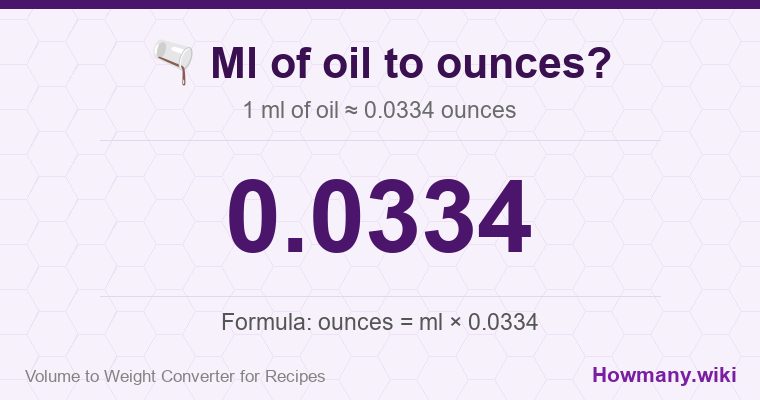
FAQs on oil volume to weight conversion
Is 250 ml of oil 8.35 ounces?
Yes — 250 ml of oil weighs 8.35 ( ~ 8 1/3) ounces, based on a density of 0.947 g/ml.
250 ml of oil equals how many ounces?
250 ml of oil is equivalent 8.35 ( ~ 8 1/3) ounces.
How much is 8.35 ounces of oil in ml?
8.35 ounces of oil equals 250 ml.
Oil Conversion Chart Near 70 Milliliters
| Milliliters to Ounces of Oil | |
|---|---|
| 70 milliliters | 2.34 ( ~ 2 1/3) ounces |
| 80 milliliters | 2.67 ( ~ 2 2/3) ounces |
| 90 milliliters | 3.01 ( ~ 3) ounces |
| 100 milliliters | 3.34 ( ~ 3 1/3) ounces |
| 110 milliliters | 3.67 ( ~ 3 2/3) ounces |
| 120 milliliters | 4.01 ( ~ 4) ounces |
| 130 milliliters | 4.34 ( ~ 4 1/3) ounces |
| 140 milliliters | 4.68 ( ~ 4 2/3) ounces |
| 150 milliliters | 5.01 ( ~ 5) ounces |
| 160 milliliters | 5.34 ( ~ 5 1/3) ounces |
| 170 milliliters | 5.68 ( ~ 5 2/3) ounces |
| 180 milliliters | 6.01 ( ~ 6) ounces |
| 190 milliliters | 6.35 ( ~ 6 1/3) ounces |
| 200 milliliters | 6.68 ( ~ 6 2/3) ounces |
| 210 milliliters | 7.01 ( ~ 7) ounces |
| 220 milliliters | 7.35 ( ~ 7 1/3) ounces |
| 230 milliliters | 7.68 ( ~ 7 2/3) ounces |
| 240 milliliters | 8.02 ( ~ 8) ounces |
| 250 milliliters | 8.35 ( ~ 8 1/3) ounces |
| 260 milliliters | 8.69 ( ~ 8 2/3) ounces |
| 270 milliliters | 9.02 ( ~ 9) ounces |
| 280 milliliters | 9.35 ( ~ 9 1/3) ounces |
| 290 milliliters | 9.69 ( ~ 9 2/3) ounces |
| 300 milliliters | 10 ( ~ 10) ounces |
| 310 milliliters | 10.4 ( ~ 10 1/3) ounces |
| 320 milliliters | 10.7 ( ~ 10 2/3) ounces |
| 330 milliliters | 11 ( ~ 11) ounces |
| 340 milliliters | 11.4 ( ~ 11 1/3) ounces |
| 350 milliliters | 11.7 ( ~ 11 2/3) ounces |
| 360 milliliters | 12 ( ~ 12) ounces |
| 370 milliliters | 12.4 ( ~ 12 1/3) ounces |
| 380 milliliters | 12.7 ( ~ 12 2/3) ounces |
| 390 milliliters | 13 ( ~ 13) ounces |
| 400 milliliters | 13.4 ( ~ 13 1/3) ounces |
| 410 milliliters | 13.7 ( ~ 13 2/3) ounces |
| 420 milliliters | 14 ( ~ 14) ounces |
| 430 milliliters | 14.4 ( ~ 14 1/3) ounces |
Note: Values are rounded to 3 significant figures. Fractions are rounded to common recipe fractions (1/8, 1/4, 1/3, 1/2, 2/3, 3/4…).
References:
Popular Volume to Weight Conversions
A note on cooking ingredients measurements
Notes: results are rounded (by default) to 3 significant figures. Cooking conversions use standard ingredient densities — the exact weight varies slightly with the brand and how tightly the ingredient is packed ☺.