HowMany.wiki
Contact Us!
Please get in touch with us if you:
- Have any suggestions
- Have any questions
- Have found an error/bug
- Anything else ...
To contact us, please click HERE.
250 Ml of Honey in Ounces
How many ounces of honey in 250 ml?
250 ml of honey equals 12.7 ( ~ 12 2/3) ounces*
About honey measurements
Few kitchen staples are as heavy as honey: at about 1.44 g/ml (FAO density database) a single US cup tips the scale near 340 g. Crystallized or creamed honey whips in tiny air pockets and measures lighter by the spoon, so gently warming it back to a clear liquid gives the steadiest weight.
Ml of honey equivalent in ounces?
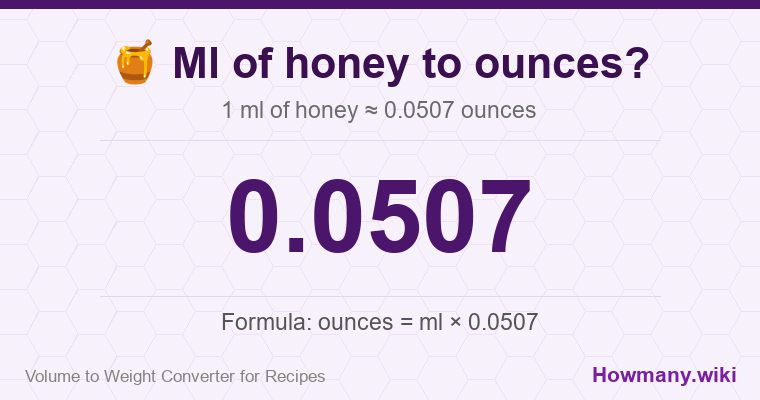
FAQs on honey volume to weight conversion
Is 250 ml of honey 12.7 ounces?
Yes — 250 ml of honey weighs 12.7 ( ~ 12 2/3) ounces, based on a density of 1.44 g/ml.
250 ml of honey equals how many ounces?
250 ml of honey is equivalent 12.7 ( ~ 12 2/3) ounces.
How much is 12.7 ounces of honey in ml?
12.7 ounces of honey equals 250 ml.
Honey Conversion Chart Near 70 Milliliters
| Milliliters to Ounces of Honey | |
|---|---|
| 70 milliliters | 3.55 ( ~ 3 1/2) ounces |
| 80 milliliters | 4.06 ( ~ 4) ounces |
| 90 milliliters | 4.56 ( ~ 4 1/2) ounces |
| 100 milliliters | 5.07 ( ~ 5 1/8) ounces |
| 110 milliliters | 5.58 ( ~ 5 1/2) ounces |
| 120 milliliters | 6.08 ( ~ 6 1/8) ounces |
| 130 milliliters | 6.59 ( ~ 6 2/3) ounces |
| 140 milliliters | 7.1 ( ~ 7 1/8) ounces |
| 150 milliliters | 7.6 ( ~ 7 2/3) ounces |
| 160 milliliters | 8.11 ( ~ 8 1/8) ounces |
| 170 milliliters | 8.62 ( ~ 8 2/3) ounces |
| 180 milliliters | 9.12 ( ~ 9 1/8) ounces |
| 190 milliliters | 9.63 ( ~ 9 2/3) ounces |
| 200 milliliters | 10.1 ( ~ 10 1/8) ounces |
| 210 milliliters | 10.6 ( ~ 10 2/3) ounces |
| 220 milliliters | 11.2 ( ~ 11 1/8) ounces |
| 230 milliliters | 11.7 ( ~ 11 2/3) ounces |
| 240 milliliters | 12.2 ( ~ 12 1/8) ounces |
| 250 milliliters | 12.7 ( ~ 12 2/3) ounces |
| 260 milliliters | 13.2 ( ~ 13 1/8) ounces |
| 270 milliliters | 13.7 ( ~ 13 2/3) ounces |
| 280 milliliters | 14.2 ( ~ 14 1/4) ounces |
| 290 milliliters | 14.7 ( ~ 14 2/3) ounces |
| 300 milliliters | 15.2 ( ~ 15 1/4) ounces |
| 310 milliliters | 15.7 ( ~ 15 3/4) ounces |
| 320 milliliters | 16.2 ( ~ 16 1/4) ounces |
| 330 milliliters | 16.7 ( ~ 16 3/4) ounces |
| 340 milliliters | 17.2 ( ~ 17 1/4) ounces |
| 350 milliliters | 17.7 ( ~ 17 3/4) ounces |
| 360 milliliters | 18.2 ( ~ 18 1/4) ounces |
| 370 milliliters | 18.8 ( ~ 18 3/4) ounces |
| 380 milliliters | 19.3 ( ~ 19 1/4) ounces |
| 390 milliliters | 19.8 ( ~ 19 3/4) ounces |
| 400 milliliters | 20.3 ( ~ 20 1/4) ounces |
| 410 milliliters | 20.8 ( ~ 20 3/4) ounces |
| 420 milliliters | 21.3 ( ~ 21 1/4) ounces |
| 430 milliliters | 21.8 ( ~ 21 3/4) ounces |
Note: Values are rounded to 3 significant figures. Fractions are rounded to common recipe fractions (1/8, 1/4, 1/3, 1/2, 2/3, 3/4…).
References:
Popular Volume to Weight Conversions
A note on cooking ingredients measurements
Notes: results are rounded (by default) to 3 significant figures. Cooking conversions use standard ingredient densities — the exact weight varies slightly with the brand and how tightly the ingredient is packed ☺.