HowMany.wiki
Contact Us!
Please get in touch with us if you:
- Have any suggestions
- Have any questions
- Have found an error/bug
- Anything else ...
To contact us, please click HERE.
150 Ml of Butter in Ounces
How many ounces of butter in 150 ml?
150 ml of butter equals 5.05 ( ~ 5) ounces*
About butter measurements
A solid stick of butter has a density near 0.96 g/ml, so a US cup, or two sticks, is about 226 g. Whipped butter is a different animal: it is beaten with air and can occupy 30–40% more volume, meaning a whipped cup falls well short of a solid one by weight.
Ml of butter equivalent in ounces?
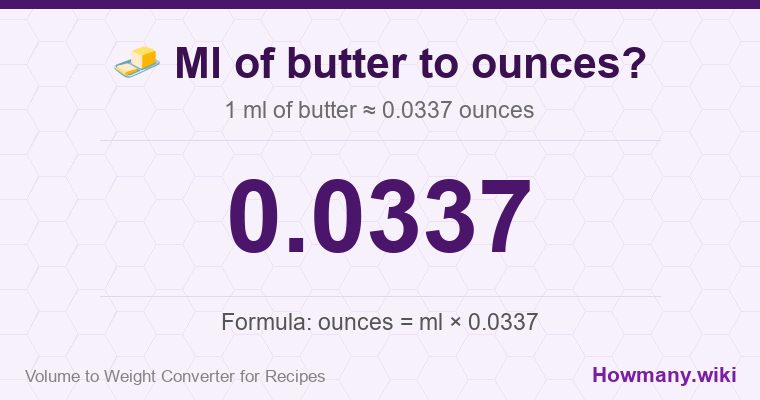
FAQs on butter volume to weight conversion
Is 150 ml of butter 5.05 ounces?
Yes — 150 ml of butter weighs 5.05 ( ~ 5) ounces, based on a density of 0.955 g/ml.
150 ml of butter equals how many ounces?
150 ml of butter is equivalent 5.05 ( ~ 5) ounces.
How much is 5.05 ounces of butter in ml?
5.05 ounces of butter equals 150 ml.
Butter Conversion Chart Near 150 Milliliters
| Milliliters to Ounces of Butter | |
|---|---|
| 150 milliliters | 5.05 ( ~ 5) ounces |
| 160 milliliters | 5.39 ( ~ 5 1/3) ounces |
| 170 milliliters | 5.73 ( ~ 5 3/4) ounces |
| 180 milliliters | 6.06 ( ~ 6 1/8) ounces |
| 190 milliliters | 6.4 ( ~ 6 1/3) ounces |
| 200 milliliters | 6.74 ( ~ 6 3/4) ounces |
| 210 milliliters | 7.07 ( ~ 7 1/8) ounces |
| 220 milliliters | 7.41 ( ~ 7 1/3) ounces |
| 230 milliliters | 7.75 ( ~ 7 3/4) ounces |
| 240 milliliters | 8.08 ( ~ 8 1/8) ounces |
| 250 milliliters | 8.42 ( ~ 8 1/2) ounces |
| 260 milliliters | 8.76 ( ~ 8 3/4) ounces |
| 270 milliliters | 9.1 ( ~ 9 1/8) ounces |
| 280 milliliters | 9.43 ( ~ 9 1/2) ounces |
| 290 milliliters | 9.77 ( ~ 9 3/4) ounces |
| 300 milliliters | 10.1 ( ~ 10 1/8) ounces |
| 310 milliliters | 10.4 ( ~ 10 1/2) ounces |
| 320 milliliters | 10.8 ( ~ 10 3/4) ounces |
| 330 milliliters | 11.1 ( ~ 11 1/8) ounces |
| 340 milliliters | 11.5 ( ~ 11 1/2) ounces |
| 350 milliliters | 11.8 ( ~ 11 3/4) ounces |
| 360 milliliters | 12.1 ( ~ 12 1/8) ounces |
| 370 milliliters | 12.5 ( ~ 12 1/2) ounces |
| 380 milliliters | 12.8 ( ~ 12 3/4) ounces |
| 390 milliliters | 13.1 ( ~ 13 1/8) ounces |
| 400 milliliters | 13.5 ( ~ 13 1/2) ounces |
| 410 milliliters | 13.8 ( ~ 13 3/4) ounces |
| 420 milliliters | 14.1 ( ~ 14 1/8) ounces |
| 430 milliliters | 14.5 ( ~ 14 1/2) ounces |
| 440 milliliters | 14.8 ( ~ 14 3/4) ounces |
| 450 milliliters | 15.2 ( ~ 15 1/8) ounces |
| 460 milliliters | 15.5 ( ~ 15 1/2) ounces |
| 470 milliliters | 15.8 ( ~ 15 3/4) ounces |
| 480 milliliters | 16.2 ( ~ 16 1/8) ounces |
| 490 milliliters | 16.5 ( ~ 16 1/2) ounces |
| 500 milliliters | 16.8 ( ~ 16 3/4) ounces |
| 510 milliliters | 17.2 ( ~ 17 1/8) ounces |
Note: Values are rounded to 3 significant figures. Fractions are rounded to common recipe fractions (1/8, 1/4, 1/3, 1/2, 2/3, 3/4…).
References:
Popular Volume to Weight Conversions
A note on cooking ingredients measurements
Notes: results are rounded (by default) to 3 significant figures. Cooking conversions use standard ingredient densities — the exact weight varies slightly with the brand and how tightly the ingredient is packed ☺.