HowMany.wiki
Contact Us!
Please get in touch with us if you:
- Have any suggestions
- Have any questions
- Have found an error/bug
- Anything else ...
To contact us, please click HERE.
1 Ml of Baking Powder in Grams
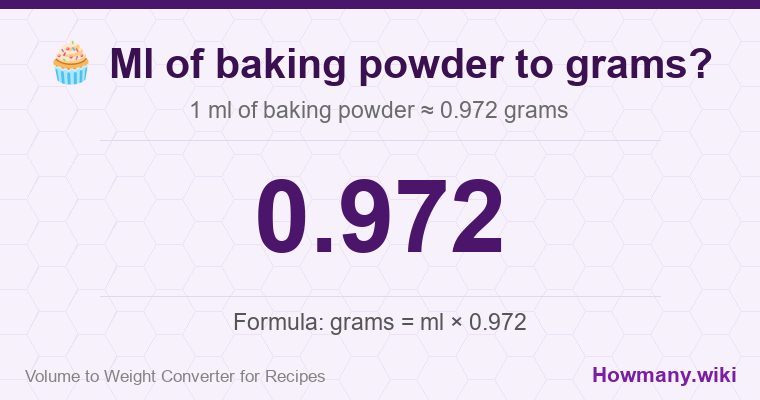
How many grams of baking powder in 1 ml?
1 ml of baking powder equals 0.972 grams*
About baking powder measurements
Baking powder settles and cakes in the tin, so the reference density used here is about 0.97 g/ml, roughly 14 g per tablespoon. Stir and lightly spoon it before leveling: a heaped, compacted teaspoon can carry half again as much leavening as a properly leveled one, throwing off delicate rises.
Ml of baking powder equivalent in grams?
FAQs on baking powder volume to weight conversion
Is 1 ml of baking powder 0.972 grams?
Yes — 1 ml of baking powder weighs 0.972 grams, based on a density of 0.972 g/ml.
1 ml of baking powder equals how many grams?
1 ml of baking powder is equivalent 0.972 grams.
How much is 0.972 grams of baking powder in ml?
0.972 grams of baking powder equals 1 ml.
Baking Powder Conversion Chart Near 1 Milliliter
| Milliliters to Grams of Baking powder | |
|---|---|
| 1 milliliter | 0.972 grams |
| 1.1 milliliters | 1.07 grams |
| 1.2 milliliters | 1.17 grams |
| 1.3 milliliters | 1.26 grams |
| 1.4 milliliters | 1.36 grams |
| 1.5 milliliters | 1.46 grams |
| 1.6 milliliters | 1.56 grams |
| 1.7 milliliters | 1.65 grams |
| 1.8 milliliters | 1.75 grams |
| 1.9 milliliters | 1.85 grams |
| 2 milliliters | 1.94 grams |
| 2.1 milliliters | 2.04 grams |
| 2.2 milliliters | 2.14 grams |
| 2.3 milliliters | 2.24 grams |
| 2.4 milliliters | 2.33 grams |
| 2.5 milliliters | 2.43 grams |
| 2.6 milliliters | 2.53 grams |
| 2.7 milliliters | 2.62 grams |
| 2.8 milliliters | 2.72 grams |
| 2.9 milliliters | 2.82 grams |
| 3 milliliters | 2.92 grams |
| 3.1 milliliters | 3.01 grams |
| 3.2 milliliters | 3.11 grams |
| 3.3 milliliters | 3.21 grams |
| 3.4 milliliters | 3.3 grams |
| 3.5 milliliters | 3.4 grams |
| 3.6 milliliters | 3.5 grams |
| 3.7 milliliters | 3.6 grams |
| 3.8 milliliters | 3.69 grams |
| 3.9 milliliters | 3.79 grams |
| 4 milliliters | 3.89 grams |
| 4.1 milliliters | 3.99 grams |
| 4.2 milliliters | 4.08 grams |
| 4.3 milliliters | 4.18 grams |
| 4.4 milliliters | 4.28 grams |
| 4.5 milliliters | 4.37 grams |
| 4.6 milliliters | 4.47 grams |
Note: Values are rounded to 3 significant figures. Fractions are rounded to common recipe fractions (1/8, 1/4, 1/3, 1/2, 2/3, 3/4…).
References:
Popular Volume to Weight Conversions
A note on cooking ingredients measurements
Notes: results are rounded (by default) to 3 significant figures. Cooking conversions use standard ingredient densities — the exact weight varies slightly with the brand and how tightly the ingredient is packed ☺.