HowMany.wiki
Contact Us!
Please get in touch with us if you:
- Have any suggestions
- Have any questions
- Have found an error/bug
- Anything else ...
To contact us, please click HERE.
Milk — Ml in Ounces
How many ounces of milk in 1 ml?
1 ml of milk equals 0.0365 ounces*
About milk measurements
Milk's density is about 1.04 g/ml (FAO density database), so a US cup weighs roughly 245 g. Counterintuitively, skim milk is slightly denser than whole milk, because milkfat is lighter than water — the more cream that is removed, the heavier the same volume becomes.
Ml of milk equivalent in ounces?
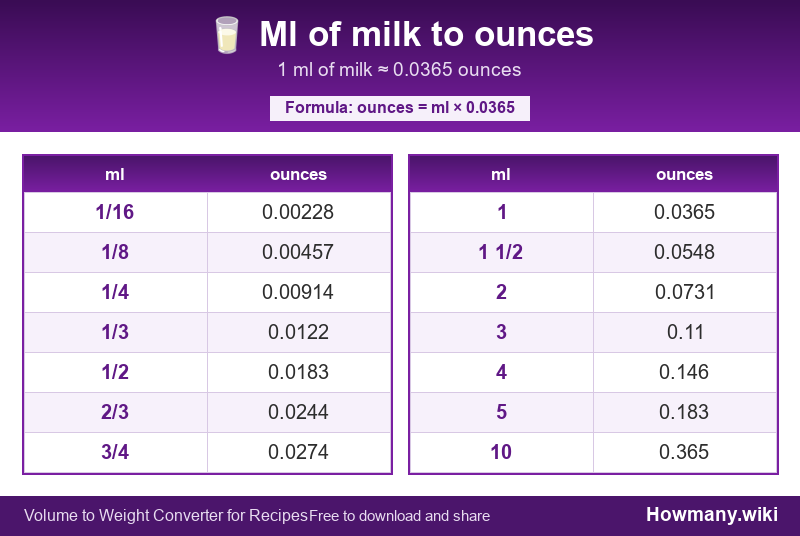
FAQs on milk volume to weight conversion
1 ml of milk equals how many ounces?
1 ml of milk is equivalent 0.0365 ounces.
How much is 0.0365 ounces of milk in ml?
0.0365 ounces of milk equals 1 ml.
Milk Conversion Chart Near 1 Milliliter
| Milliliters to Ounces of Milk | |
|---|---|
| 1 milliliter | 0.0365 ounces |
| 1.1 milliliters | 0.0402 ounces |
| 1.2 milliliters | 0.0439 ounces |
| 1.3 milliliters | 0.0475 ounces |
| 1.4 milliliters | 0.0512 ounces |
| 1.5 milliliters | 0.0548 ounces |
| 1.6 milliliters | 0.0585 ounces |
| 1.7 milliliters | 0.0621 ounces |
| 1.8 milliliters | 0.0658 ( ~ 1/8) ounces |
| 1.9 milliliters | 0.0694 ( ~ 1/8) ounces |
| 2 milliliters | 0.0731 ( ~ 1/8) ounces |
| 2.1 milliliters | 0.0767 ( ~ 1/8) ounces |
| 2.2 milliliters | 0.0804 ( ~ 1/8) ounces |
| 2.3 milliliters | 0.0841 ( ~ 1/8) ounces |
| 2.4 milliliters | 0.0877 ( ~ 1/8) ounces |
| 2.5 milliliters | 0.0914 ( ~ 1/8) ounces |
| 2.6 milliliters | 0.095 ( ~ 1/8) ounces |
| 2.7 milliliters | 0.0987 ( ~ 1/8) ounces |
| 2.8 milliliters | 0.102 ( ~ 1/8) ounces |
| 2.9 milliliters | 0.106 ( ~ 1/8) ounces |
| 3 milliliters | 0.11 ( ~ 1/8) ounces |
| 3.1 milliliters | 0.113 ( ~ 1/8) ounces |
| 3.2 milliliters | 0.117 ( ~ 1/8) ounces |
| 3.3 milliliters | 0.121 ( ~ 1/8) ounces |
| 3.4 milliliters | 0.124 ( ~ 1/8) ounces |
| 3.5 milliliters | 0.128 ( ~ 1/8) ounces |
| 3.6 milliliters | 0.132 ( ~ 1/8) ounces |
| 3.7 milliliters | 0.135 ( ~ 1/8) ounces |
| 3.8 milliliters | 0.139 ( ~ 1/8) ounces |
| 3.9 milliliters | 0.143 ( ~ 1/8) ounces |
| 4 milliliters | 0.146 ( ~ 1/8) ounces |
| 4.1 milliliters | 0.15 ( ~ 1/8) ounces |
| 4.2 milliliters | 0.153 ( ~ 1/8) ounces |
| 4.3 milliliters | 0.157 ( ~ 1/8) ounces |
| 4.4 milliliters | 0.161 ( ~ 1/8) ounces |
| 4.5 milliliters | 0.164 ( ~ 1/8) ounces |
| 4.6 milliliters | 0.168 ( ~ 1/8) ounces |
Note: Values are rounded to 3 significant figures. Fractions are rounded to common recipe fractions (1/8, 1/4, 1/3, 1/2, 2/3, 3/4…).
References:
Popular Volume to Weight Conversions
A note on cooking ingredients measurements
Notes: results are rounded (by default) to 3 significant figures. Cooking conversions use standard ingredient densities — the exact weight varies slightly with the brand and how tightly the ingredient is packed ☺.